
Sturgeon
~160,000,000 BCE - 2026 • Hudson River
VIDEO COMING SOON
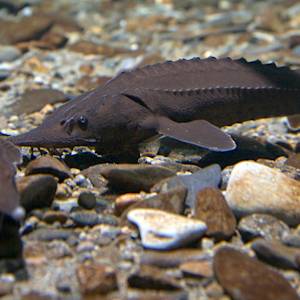
Called “living fossils” Sturgeons evolved over 160 million years ago and survived the mass extinction that killed the dinosaurs. Most spend their lives in the ocean, and migrate up rivers to spawn in freshwater. When European settlers arrived in North America, spawning runs were so numerous they could capsize fishing boats. In New York, sturgeon earned the nickname “Albany beef,” and caviar was served for free at bars across New York City. In the 1880s the US became the world’s largest caviar exporter, but by the 1920s Sturgeon began disappearing from the Hudson. Around the world, overfishing pushed them to the brink of extinction, compounded by damming, dredging, and contamination of their riverine habitats. Since 1970, populations crashed by 94%.
- In 2010, the IUCN declared them
WHAT YOU CAN DO
Choose sustainably farmed caviar.
Support river restoration and dam removal projects that reopen historic sturgeon spawning habitat.
Support fishing regulations and moratoriums that protect remaining wild sturgeon populations.
Audio and Video Pond5
Nordhaus H. (11 Mar 2025) “These ancient fish swam with the dinosaurs. They may not survive us.” National Geographic.
Revkin A. (7 Mar 2019) “14-foot fish spotted in river, giving hope to vanished giant’s return.” National Geographic
Dudu A., Georgescu S. (21 Aug 2024) “Exploring the Multifaceted Potential of Endangered Sturgeon: Caviar, Meat and By-Product Benefits”
Cassidy B. (29 Mar 2025) “Once in Dire Straits, Atlantic Sturgeon Are Staging a Comeback on the East Coast” Smithsonian Magazine.

Learn about Maya Lin’s fifth and final memorial: a multi-platform science based artwork that presents an ecological history of our world - past, present, and future.
Discover ecological histories and stories of former abundance, loss, and recovery on the map of memory.
Learn how we can reduce our emissions and protect and restore species and habitats – around the world.

See how art can help us rethink the problems we face, and give us hope that each one of us can make a difference.

Help make a global memorial something personal and close to home. Share your stories of the natural world.